Posts

Second Sunday of Lent [B]
Image
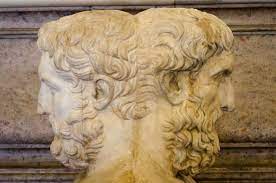
  SECOND SUNDAY OF LENT [B] Imagine yourself working at the Vatican museum. You find yourself surrounded by thousands of masterpieces—over 700,000 spread across 54 galleries! Today, you’re setting up a new exhibit, an exhibit that will feature a bust of the mythological Roman god, Janus. Normally, when a bust is being displayed, you want it to face in a forward direction. However, in this instance, you’re not sure about how to proceed. Two faces have been sculpted onto this particular bust. Janus is traditionally depicted as gazing simultaneously forward and backwards. He is the god of portals, the god of doorways, of gateways, and of transitions. The Janus myth anticipates a principle that will be outlined later on in history by the philosopher Soren Keirkegaard (1813-1855): you understand your life by looking backwards, and you live your life by looking forward.  Why spend time on this Roman god when we’re supposed to be focusing upon the God of the Bible? It has to do w...

First Sunday of Lent [B]

Image
FIRST SUNDAY OF LENT [B] We hear about Jesus spending time in the desert. How much time? Forty days, according to the Gospel of Mark (1:13). This number shows up regularly within the pages of sacred scripture. Consider the case of Noah: the ark becomes necessary because it continues to rain, day after day. How many days exactly? We’re told that it rained for forty days and forty nights (Gen. 7:12). Moses will spend a period of time on Mt. Sinai, communing with the Lord. How much time? It will be forty days, according to the Book of Exodus. How many years will pass before the Israelites finally enter into the Promised Land? They require forty years of formation. The Ninevites are given how many days to repent? Forty days, according to the Book of Jonah. The prophet Elijah’s journey to Mt. Horeb will span how many days? Forty days, according to the First Book of Kings.  Perhaps you’re wondering why the number forty carries so much significance? It apparently has to do with the Ten Co...

Homily For Valentine's Day

Image
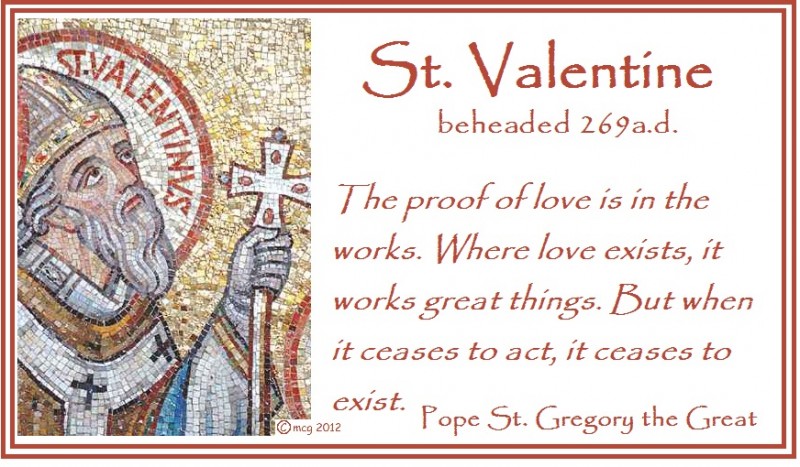
  HOMILY FOR VALENTINE’S DAY We’ll begin this Valentine’s reflection by focusing upon the ritual flow of the Mass. Roman Catholic worship involves more than just gathering together, listening to scripture, and raising our voices in song. We employ the elements of bread and wine, drawing from the example Jesus provides at the Last Supper. Bread and wine are brought forward by volunteers recruited from within the assembly. The elements will be received, placed upon the altar, prayed over, transformed, and finally distributed to those who approach the altar in procession. When the worship concludes, those who have gathered are sent forth, tasked with the responsibility of enriching the wider world, as leaven brings texture and elevation to the bread that you bake in your oven. In fact, the word “Mass” derives from the Latin expression: YOU ARE SENT. We are enriched and fortified, for a particular purpose: the purpose of impacting the wider world, making the Kingdom of God increasingly...

Sixth Sunday, Ordinary Time [B]

Image
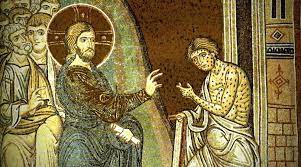
  SIXTH SUNDAY OF ORDINARY TIME Jesus performs a healing, but he insists that the healing should receive nothing in the way of publicity (see Mark 1:40-45). You can’t help wondering, why keep something like this quiet? You’re perplexed, and yet you make the choice to read on. Eventually you come to realize that additional pieces have to be put into place. Jesus wants to be understood as a particular kind of Messiah—a Messiah who operates outside of the box.  This information helps you as you read along. It’s helpful because the reading from Leviticus has left a bad taste within your mouth (13:38-46). Imagine being in that situation! Imagine what it would have meant for an Old Testament Hebrew, contracting the disease of leprosy. The condition is devastating enough; then you factor in the experience of being ostracized, declared ritually “unclean.”  The passage disturbs you deeply. It breaks your heart. And still, you read on.  By reading on, you finally encounter Ma...

Fifth Sunday, Ordinary Time [B]

Image
  FIFTH SUNDAY OF ORDINARY TIME [B] Job speaks for each and every one of us: he wants to be blessed. It’s safe to say that we all want to be blessed. And for Job, the blessings do arrive—eventually. He has to undergo a period of waiting. Additionally, he has to straighten up his attitude. But finally, when we reach chapter 42, the blessings begin to take shape, they begin to materialize.  We want our own experience of chapter 42. Bring on the blessings, Lord! And there is nothing wrong with that. You’re well within your rights, when you seek blessings from above. For the sake of argument, suppose the blessings arrive tomorrow. How will you respond? The hope is that you will respond according to the pattern outlined in Mark chapter one. Simon Peter’s mother-in-law has taken ill. Like Job, she needs to be blessed. Having received her blessing, she responds, springing up, waiting on Jesus and his disciples (1:31).  In basic terms, she receives a blessing and subsequently s...

Fourth Sunday, Ordinary Time [B]

Image
  FOURTH SUNDAY OF ORDINARY TIME [B] Paul favors the celibate life (1st Cor. 7:1-7). But clearly he’s not speaking with a prophetic voice. He presents his point of view as solid advice, not as an authoritative body of teaching (vs. 6). He understands our world as something that will pass away (7:31). Therefore, it’s best to limit the number of your attachments. At other times, Paul will express himself more authoritatively, using the kind of approach that an Old Testament prophet might use. However, in this case, he’s more of an advisor than a prophet.  What do we know about the Old Testament prophets? They don’t appear until after the covenant has been established. Through Abraham a covenant will be initiated. And then through Moses that covenant will eventually be formalized. Deuteronomy 18 outlines a prophetic line that will subsequently be put into place. The prophet’s responsibility will be to call out when members of society begin to turn away from the principles of the ...

Third Sunday, Ordinary Time [B]

Image
  THIRD SUNDAY OF ORDINARY TIME [B] What do we find when we look in on the Ninevites? They are in the process of responding to the prophecy delivered by Jonah (Jonah 3:1-10). Moving along, what do we find when we look in on the fishermen? They are in the process of responding to the call of Jesus (Mark 1:16-20). Now we need to consider our own status: are we in the process of responding to any particular message or proclamation? What about this selection from St. Paul? According to Paul, the world as we know it will be passing away (1st Cor. 7:31). How should we be responding, if the world we inhabit is to be understood as a passing world?  Should we be applying ourselves? Why bother, if the world is passing away? Why should you attempt to make the world a better place, if it’s a transitory world? A hands-off approach would seem to be the appropriate approach. And yet, if you page through the Bible, the hands-on approach is being prescribed, over and over again. The world p...